On a day trip, you can visit the Old Main Bridge, the Town Hall and Grafeneckart, Market Square with the Falkenhaus and St Mary’s Chapel, St Kilian’s Cathedral and the Würzburg Residence. These sights can easily be combined on a walking tour of the city centre.
Destination
Discover Würzburg: a walking tour of the city’s top sights
highlight
Interesting Facts
Fine wine
Castles
Historically Relevant
Discover Würzburg on a day trip by rail. Walk to the Old Main Bridge, Market Square, St Kilian’s Cathedral and the UNESCO-listed Residence.
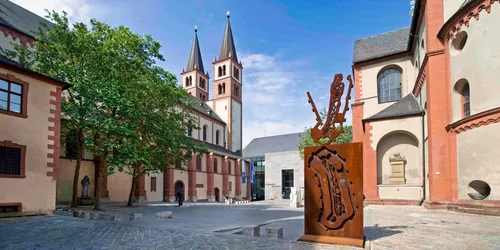
From the Old Main Bridge to the Würzburg Residence, this university city in the heart of Franconia offers countless picture-postcard views. On a walk from the central station through the Old Town, you can discover historic buildings, Franconian wine culture and some of Würzburg’s best-known sights.
Würzburg is one of Bavaria’s oldest cities and has been shaped by its history as an episcopal seat, university city and centre of Franconian wine. Baroque splendour, medieval churches and vineyards beside the River Main are all located close together and are easy to explore on a day trip by rail.
From Würzburg Central Station to the Old Town
Your city walk begins at Würzburg Central Station. From the station forecourt, Kaiserstraße leads directly towards the city centre. On your way to the Old Main Bridge, you will gain a first impression of Würzburg’s lively centre with its shops, squares and historic façades.
After walking through the city centre, you reach the River Main and the first major sight on the tour. Even before stepping onto the bridge, the view opens across the river towards Marienberg Fortress and the vineyards on the opposite bank.
Old Main Bridge: Würzburg’s meeting place above the river
The Old Main Bridge is one of Würzburg’s landmarks. A stone bridge stood on this site as early as the Middle Ages. The piers of the later replacement were built between 1476 and 1488, while construction of the stone arches began in 1512.
Around 1730, the bridge gained its characteristic statues of saints, each approximately 4.5 metres tall. These Baroque figures give it a slight resemblance to the famous Charles Bridge in Prague. From the bridge, you can enjoy far-reaching views across the River Main to Marienberg Fortress, the Käppele pilgrimage church and the surrounding vineyards.
One of Würzburg’s most popular traditions is the Brückenschoppen. Residents and visitors meet on the bridge to enjoy a glass of Franconian wine and take in the view together. If you are lucky, street musicians will provide a soundtrack to your stop above the river.
Würzburg Town Hall and the Grafeneckart
From the Old Main Bridge, the tour continues to Würzburg Town Hall, only a few minutes away on foot. The complex brings together buildings from several different periods. Its most distinctive feature is the Grafeneckart with its 55-metre tower, which can be seen from a considerable distance.
The oldest sections of this originally Romanesque building date from the 13th century, making it one of the city’s oldest surviving secular structures. In front of the Town Hall, the Four Tubes Fountain recalls Würzburg’s Baroque history.
Market Square, Falkenhaus and St Mary’s Chapel
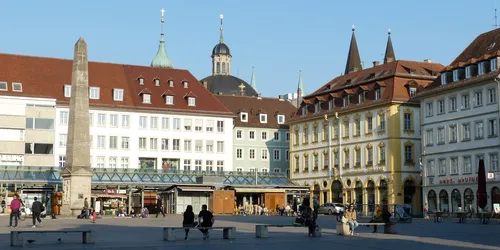
From the Town Hall, the walking tour continues to Würzburg’s Market Square. Here, two particularly characteristic sights stand directly beside one another: the Falkenhaus and St Mary’s Chapel.
The Falkenhaus immediately catches the eye with its curved gables and richly decorated Rococo façade. Its stucco ornamentation was created in 1751. After the building was largely destroyed in 1945, it was reconstructed using historic photographs. Today, it houses the Tourist Information Office and the city library.
Beside it stands the Late Gothic St Mary’s Chapel. Construction began in 1377 and was completed towards the end of the 15th century. The sculptural decoration around its portals is particularly impressive. The figures of Adam and Eve displayed there are copies of famous works by Tilman Riemenschneider; the originals are preserved in the Museum für Franken.
St Kilian’s Cathedral in Würzburg
Your day trip to Würzburg should include a visit to the imposing St Kilian’s Cathedral. From the Market Square, it is only a few minutes away along Domstraße. Construction of the present cathedral began in 1040, and its twin towers continue to shape Würzburg’s skyline.
Würzburg Cathedral is considered the fourth-largest Romanesque church in Germany and is impressive both inside and out. Its interior has been redesigned several times during its history of almost a thousand years and was rebuilt after the destruction of the Second World War.
The Schönborn Chapel adjoining the cathedral is particularly worth seeing. This masterpiece by the Baroque architect Balthasar Neumann served as a burial chapel for the prince-bishops of the Schönborn family. Its richly decorated façade forms an impressive contrast to the cathedral’s Romanesque architecture.
Würzburg Residence: a Baroque UNESCO World Heritage Site
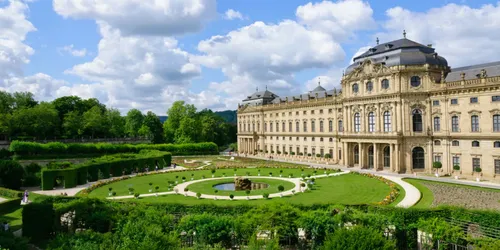
The final major stop on the walking tour is the Würzburg Residence. From the cathedral, walk across Paradeplatz and follow Hofstraße to the monumental Baroque palace. The Residence was built in the 18th century to plans by Balthasar Neumann. Together with the Court Garden and Residence Square, it was added to the UNESCO World Heritage List in 1981.
During a tour, you can explore around 40 period rooms containing furniture, tapestries, paintings and other 18th-century art treasures. Highlights include the famous staircase with its monumental ceiling fresco by Giovanni Battista Tiepolo, the magnificent Imperial Hall and the reconstructed Mirror Cabinet.
The Imperial Hall impresses with its stucco decoration and Tiepolo’s historical scenes. Decorated with reverse-painted glass and mirrored surfaces, the Mirror Cabinet is regarded as an outstanding Rococo interior. After being completely destroyed in 1945, it was reconstructed between 1979 and 1987 using historical sources and traditional techniques.
A special Würzburg tip in spring is to visit the Court Garden during the cherry blossom season. When delicate pink flowers appear among the Baroque hedges, the already impressive garden becomes particularly atmospheric. At other times of year, the grounds are equally inviting for a walk after your visit to the palace.
Franconian wine at the Bürgerspital Weinstuben
After exploring Würzburg’s sights, you can reflect on the day over Franconian and German cuisine at the Bürgerspital Weinstuben. The history of the Bürgerspital dates back to 1316. Vineyards donated to support the institution formed the basis of one of Würzburg’s traditional wineries.
The wine taverns are located on Theaterstraße, conveniently situated on the way back to the central station. Here, you can end your tour over a glass of Silvaner or another Franconian wine.
Return home by rail
Würzburg Central Station is only a short walk from Theaterstraße. On your journey home by rail, you can reflect on the impressions of the day: the statues on the Old Main Bridge, the cathedral towers, the Rococo façade of the Falkenhaus and the magnificent rooms of the Residence.
The DB Regio Bayern audio guide also takes you on an interactive journey aboard the Main-Spessart Express from Aschaffenburg to Würzburg. Listen to the episode and plan your next day trip by rail!
FAQs
Würzburg can be reached by rail from many cities in Bavaria and Franconia, either directly or with only a few changes. Kaiserstraße leads from Würzburg Central Station into the city centre, while Market Square, the cathedral and the Old Main Bridge are all within walking distance.
A compact route leads from the central station to the Old Main Bridge and continues past the Town Hall to Market Square, St Kilian’s Cathedral and the Residence. From there, you can return to the station via Theaterstraße.
The Old Main Bridge is a distinctive Würzburg landmark with a series of Baroque statues of saints. From the bridge, you can look across the River Main towards Marienberg Fortress, the Käppele and the surrounding vineyards.
A Brückenschoppen is a glass of Franconian wine enjoyed on the Old Main Bridge. Residents and visitors meet there to drink wine and take in the views of the river, Marienberg Fortress and the vineyards.
Around 40 period rooms containing furniture, paintings, tapestries and other art treasures are open to visitors. Highlights include the staircase with Tiepolo’s ceiling fresco, the Imperial Hall and the reconstructed Mirror Cabinet.
The Würzburg Residence, Court Garden and Residence Square have been a UNESCO World Heritage Site since 1981. The complex is recognised as an outstanding example of European Baroque architecture and is closely associated with the architect Balthasar Neumann.
Würzburg is particularly well known for Franconian Silvaner. Riesling and Pinot varieties are also grown in the vineyards around the city and are often sold in the traditional flattened Bocksbeutel bottle.

Arrival
Tourist Information & Ticket
Marktplatz 9
97070 Würzburg
Marktplatz 9
97070 Würzburg
Würzburg Hbf
Our tip: Please make sure to check your train connection and the expected capacity before you start your journey.