Yes, Augsburg is an excellent destination for a day trip. Many famous sights, including the Town Hall, the Lechviertel, the Fuggerei and the Augsburger Puppenkiste, can be combined on a walking tour of the city centre.
Destination
Augsburg's sights and insider tips
City Trip
Historically Relevant
Events
all-season
rest stop
Go on a discovery tour in Augsburg and experience an unforgettable day in the city with many faces.
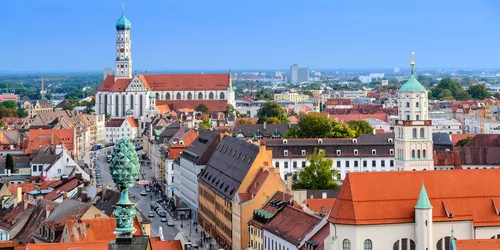
Augsburg is Bavaria’s third-largest city after Munich and Nuremberg and one of the oldest cities in Germany. The Roman settlement of Augusta Vindelicum became a medieval episcopal seat, later a regular venue for imperial diets and finally the famous home of powerful patrician families. Augsburg’s rich history has left many traces across the cityscape.
From Augsburg Central Station to the Great Synagogue
Begin your day trip at Augsburg Central Station and follow Halderstraße. The first of Augsburg’s sights is located directly along the route: the Great Synagogue. Built between 1913 and 1917, this monumental structure combines Art Nouveau influences with Byzantine and Oriental elements. Its 29-metre-high dome covered in green and gold mosaics is particularly impressive.
The synagogue remains the centre of Augsburg’s Jewish community. One branch of the Jewish Museum Augsburg Swabia is housed in its western wing. As the synagogue complex is undergoing renovation and access arrangements may change, check the museum’s website for current visitor information before your trip.
Augsburg Armoury by Elias Holl
Continue along Halderstraße and turn left into Konrad-Adenauer-Allee. The route then leads right across Königsplatz and through Zeuggasse until you reach the Armoury. Few architects have shaped Augsburg’s appearance as strongly as Elias Holl. This imposing building is one of his earliest surviving works. Originally an arsenal with accommodation for soldiers, it is now an educational and community centre in the heart of the city.
The fountain courtyard is an inviting place to pause. For a culinary break, visit the adjoining Zeughaus-Stuben, which serves Bavarian-Swabian dishes and has a beer garden. It is a useful Augsburg tip for anyone wishing to combine sightseeing with a leisurely meal.
Lechviertel: Augsburg’s romantic Little Venice
On the way to the historic Town Hall, leave Maximilianstraße behind and stroll through the romantic Lechviertel. With its narrow winding lanes, small shops and numerous waterways, the district lives up to its nickname, “Little Venice”. Water ripples through the canals between historic façades, accompanying you on your walk through Augsburg’s Old Town.
The extensive historic centre is one of the highlights of this city tour. Protected squares, streetscapes and former artisans’ houses tell the story of this characterful district. The canals are also a reminder of Augsburg’s sophisticated Water Management System, which is recognised as a UNESCO World Heritage Site.
Augsburger Puppenkiste: Jim Button, Urmel and Kasperl
The southern part of the Lechviertel is home to the famous puppet theatre that has captivated children and adults for generations: the Augsburger Puppenkiste. Since opening in 1948, it has brought its marionettes to life on stage. Many of its characters have become legendary, including Kasperl, Jim Button and Luke the Engine Driver, Urmel and the Sams.
In the adjoining “die Kiste” puppet theatre museum on the first floor of the listed Heilig-Geist-Spital, you can encounter famous marionettes in familiar stage sets. Changing special exhibitions complement the permanent display and offer insights into the theatre’s history and the art of puppetry.
Augsburg Town Hall and the Golden Hall
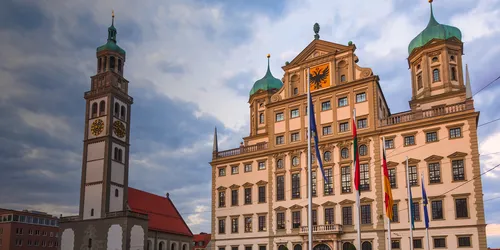
The next stop is Augsburg Town Hall. Completed in 1624, the Renaissance building also bears the signature of Elias Holl and is one of Europe’s most important secular Renaissance structures. Together with the adjoining Perlachturm, which rises to almost 60 metres, the Town Hall forms one of Augsburg’s best-known landmarks.
The Perlachturm is currently undergoing extensive renovation and cannot be climbed. Nevertheless, its distinctive structure continues to shape Rathausplatz during the work. The monumental façade of the neighbouring Town Hall is also well worth a closer look.
Inside, the Golden Hall impresses with its magnificent decoration. Extending across several storeys, the lavishly gilded ceremonial hall is considered a highlight of Renaissance interior design. As the Town Hall may occasionally close for renovation work or events, check whether the hall is accessible before visiting.
The Fuggerei: the world’s oldest social housing complex
Your tour of Augsburg’s sights then continues along Am Perlachberg to the Fuggerei, the oldest existing social housing complex in the world. This picturesque collection of terraced houses was founded by Jakob Fugger in 1521 and continues to provide homes for Augsburg residents in need.
Beyond its gates lies a small “city within a city” with yellow façades, green shutters, quiet lanes and carefully tended green spaces. Its museums and exhibitions recount the foundation’s history, the daily lives of former and present residents, and the Fuggerei’s destruction and reconstruction. A display residence also offers an impression of life in the community today.
The Fuggerei is famous and consequently attracts plenty of visitors. If you need a break from the crowds, you will find less familiar lanes with a romantic medieval atmosphere behind this “city within a city”. Along winding streets with names such as Wämstlergäßchen and Auf dem Plätzchen, Augsburg’s historic centre reveals another side of its character.
Follow in Bertolt Brecht’s footsteps through Augsburg
Just a few minutes’ walk from the Fuggerei stands the birthplace of Augsburg’s famous playwright and poet Bertolt Brecht. A red figure marks the entrance to the Brecht House. The exhibition devoted to the creator of works such as “The Threepenny Opera” and “Mother Courage and Her Children” features valuable original documents and first editions.
Photographs, documents, audio recordings and films provide insights into Brecht’s life, work and relationship with his native city. A video guide complements the exhibition and takes you even deeper into Brecht’s world.
Bavarian-Swabian cuisine at the historic Bauerntanz
Round off your eventful day exploring Augsburg’s sights and hidden corners at the Bauerntanz. This traditional 16th-century inn in the heart of the Old Town serves hearty Bavarian-Swabian dishes prepared with regional and seasonal ingredients.
From the Brecht House, follow the street Auf dem Rain and continue onto Barfüßerstraße. Turn left into Mittlerer Lech. Once you reach Bauerntanzgäßchen, your evening meal is only a few metres away.
Walk through Augsburg’s Old Town to the central station
On your way back to the station, enjoy the historic atmosphere of one of Germany’s oldest cities one last time. Begin on Weiße Gasse, turn right onto Judenberg and walk across Moritzplatz to Bürgermeister-Fischer-Straße. From there, the route leads across Königsplatz and along Bahnhofstraße directly to Augsburg Central Station.
On your journey home by rail, you can reflect on the impressions of a varied day: from the Great Synagogue and the canals of the Lechviertel to the Renaissance Town Hall, the Fuggerei and the quiet lanes of the Old Town.
Discover Augsburg with the audio guide
Would you like to experience Augsburg from another perspective? The DB Regio Bayern audio guide “Augsburg – a journey through the Renaissance city” takes you on an interactive tour. Listen in and be inspired!
FAQs
Augsburg can be reached by rail from many cities in Bavaria, either directly or with only a few changes. Augsburg Central Station is close to the city centre and is a convenient starting point for a walking tour.
From the central station, Bahnhofstraße leads across Königsplatz towards the Old Town. The first stops on the route, including the Great Synagogue and the Armoury, are only a few minutes away on foot.
Yes, many sights in central Augsburg are located close together and are easy to explore on foot. The route connects the Great Synagogue, the Lechviertel, the Town Hall, the Fuggerei and the Brecht House.
Augsburg’s best-known sights include the Renaissance Town Hall with the Golden Hall, the Perlachturm, the Lechviertel and the Fuggerei. The Great Synagogue, the Augsburger Puppenkiste and the Brecht House are also interesting stops on a city tour.
Allow at least half a day for a walking tour of the main sights. A full day is worthwhile if you want to spend more time at the Fuggerei, visit a museum or see the Augsburger Puppenkiste.
Founded by Jakob Fugger in 1521, the Fuggerei is the oldest existing social housing complex in the world. Augsburg residents in need still live there today, while museums and a display residence explain the community’s history and daily life.
Yes, Augsburg offers several family-friendly attractions. Popular choices include the Augsburger Puppenkiste and its museum, the narrow lanes and canals of the Lechviertel, and the Fuggerei.


Arrival
Augsburg City Hall
Rathausplatz 2
86150
Rathausplatz 2
86150
Augsburg Hbf
Our tip: Please make sure to check your train connection and the expected capacity before you start your journey.