Destination
Maximiliansgrotte near Neuhaus: a walk to Germany’s largest stalactite
Hiking Trails
Program & Tours
rest stop
Step by step, you descend into a world of rock, darkness and stalactites: inside the Maximiliansgrotte, Germany’s largest stalactite – the ‘Eisberg’ – awaits.
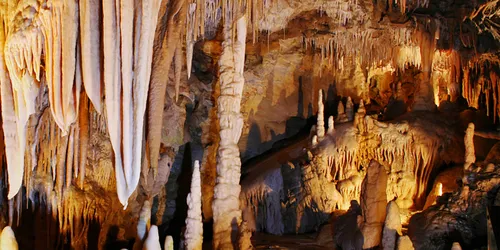
Hidden amongst the woods near Krottensee lies a cave labyrinth more than 1,200 metres long. On a guided tour of the Maximiliansgrotte, you’ll descend up to 70 metres below the earth’s surface. Amidst towering rock faces, narrow passages and bizarre stalactites, you’ll eventually come across the ‘Eisberg’ (Iceberg), which is considered Germany’s largest stalactite.
Through the cave labyrinth of the Maximiliansgrotte
The guided tour, which lasts around half an hour, begins at an unassuming wooden door. Behind it, a steep staircase leads down into the mountain. Daylight fades, the air grows cooler and, in the subdued light of the cave lighting, the contours of the limestone world slowly emerge.
The Maximiliansgrotte consists of several chambers and passages, whose formations bear imaginative names. In the Adlergrotte, parts of the rock resemble outstretched bird’s wings. In the ‘Orgelgrotte’ (Organ Cave), the stalactites and stalagmites resemble stone organ pipes. Along the way, you’ll also discover formations known as the ‘Elephant’, ‘Angel’, ‘Baptismal Font’ or ‘Our Lady’.
The Leißnerdom is particularly impressive. Around 26 metres above the cave floor, the so-called ‘Windloch’ (wind hole) opens up – the original entrance to the grotto. Daylight streams through the opening into the large hall, casting bright patches onto the dark rock walls.
The Iceberg: Germany’s largest stalagmite
The most famous natural formation in the Maximiliansgrotte is located in the treasure chamber: the ‘Eisberg’, which is around six metres high, is considered Germany’s largest stalagmite. It owes its name to its light-coloured, massive form, which seems to rise up from the cave floor.
It was formed over a period of time that is almost impossible to imagine. Mineral-rich water seeps through fine cracks in the limestone and, with every drop, deposits tiny amounts of calcium carbonate. Over thousands of years, this slow process gives rise to the stalactites and formations that you will see during the guided tour.
The Maximiliansgrotte can only be visited on a guided tour
The cave can only be visited as part of a guided tour. The route involves climbing many steps and passing through passages that are, in places, narrow and low. Sturdy footwear and an extra warm layer of clothing are recommended, as it remains cool underground even on hot summer’s days.
The regular season generally runs from April to the end of October. Guided tours mainly take place on Saturdays, Sundays and public holidays; additional tours are offered in August. From 1 November until early April, the grotto is closed to protect the hibernating bats. As there may also be occasional closures during the season, you should check the current calendar on the Maximiliansgrotte website.
Walk from Neuhaus railway station to the Maximiliansgrotte
The cave tour can be easily combined with the Karst Nature Trail. The circular route, which is around twelve kilometres long, starts and ends at Neuhaus railway station on the Pegnitz. Follow the markings with the green dot through woods and meadows to smaller caves, rock formations and other features of the karst landscape.
You should allow around four hours for the walk, not including a visit to the cave. Some sections run along unpaved forest paths and include steep inclines. Sturdy footwear, plenty of water and sure-footedness are therefore essential for this walk. You can find a detailed description and a GPS track on the VGN website.
Stop for a bite to eat at the Gasthof Grottenhof
The Gasthof Grottenhof is situated right next to the Maximiliansgrotte. The menu features Franconian and Upper Palatinate dishes, homemade wood-fired bread and the inn’s own cheese, which is matured in the Maximiliansgrotte. You should check the opening hours and closing days alongside the guided tour dates.
If you’d like to discover more of Bavaria’s underground world, you’ll find further destinations in the feature article Caves in Bavaria. Another well-known show cave in the region is the Pottenstein Devil’s Cave.
FAQs
Arrival
Maximilian’s Grotto
Krottensee Grottenhof
91284 Neuhaus on the Pegnitz
Krottensee Grottenhof
91284 Neuhaus on the Pegnitz
Neuhaus (Pegnitz)
Our tip: Please make sure to check your train connection and the expected capacity before you start your journey.