Destination
The Franconian Open-Air Museum in Bad Windsheim: Experience 700 years of history
Program & Tours
Gastronomic History
Historically Relevant
Gardens and parks
rest stop
Historic farmhouses, traditional crafts and animal inhabitants: at the Franconian Open-Air Museum, we discover 700 years of everyday Franconian history.
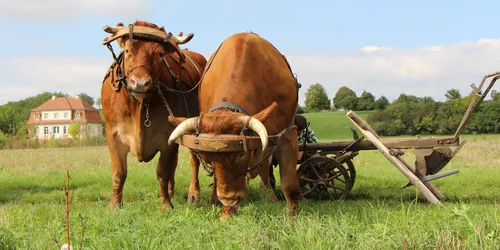
At the Franconian Open-Air Museum in Bad Windsheim, we take a journey through 700 years of Franconian everyday history. More than 100 historic buildings, workshops, fields and gardens show how people in Franconia used to live and work. Animals, craft demonstrations and hands-on activities make a visit to the museum a varied day out, especially for families.
700 years of Franconian history in the open air
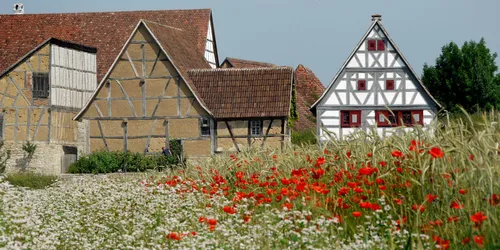
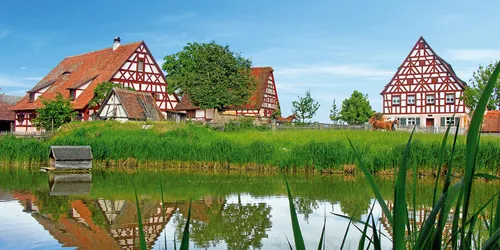
How did people live when water still came from wells, food was grown on their own land and much of the work was done entirely by hand? We find the answers at the Franconian Open-Air Museum in Bad Windsheim. Amidst farms, mills, barns, workshops, breweries and inns, the tour feels like a stroll through several Franconian villages.
The buildings are not mere replicas. Historic houses from various parts of Franconia were carefully dismantled at their original sites and rebuilt at the museum. Their furnished parlours, kitchens, stables and workshops tell the story of the everyday lives of the people who once lived and worked there.
The landscape is also part of the museum experience. Regional varieties of fruit, vegetables and cereals grow amongst the houses. Gardens, fields and orchard meadows show just how closely rural life was shaped by the seasons, the harvest and livestock farming. When a Swabian-Hällisch pig comes grunting round the corner, sheep wander across the pasture or a Franconian country goose loudly defends its yard, historic village life seems to come back to life.
Seven building groups showcase the diversity of Franconia
The buildings are divided into seven groups. Three of these are dedicated to the Franconian regions of Mainfranken–Frankenhöhe, Regnitzfranken–Frankenalb and Altmühlfranken. Four further groups focus on the Middle Ages, the 20th century, and technology and trade. Added to these is the ‘Town’ group in the historic old town of Bad Windsheim.
This complex includes the Spitalkirche, the Alte Bauhof and the herbal pharmacy. The Spitalkirche houses the Church in Franconia museum. It sheds light on the history of church life in Franconia and illustrates how strongly religion, festivals and customs shaped the everyday lives of earlier generations.
The extensive grounds can be explored via various circular walks. Overview maps are available at the ticket office and on the museum’s website, including information on routes with the best possible accessibility.
Experience traditional crafts in Bad Windsheim
The historic workshops are not just exhibition spaces. During the peak season, there are regularly changing craft demonstrations. Here, for example, you can see how fabric is woven, wool is spun, metal is forged, bread is baked or wood is worked. Trades such as cooperage, basket-making and clog-making are also showcased on selected days.
The demonstrations on offer depend on the day of your visit. There are also special exhibitions, guided tours, courses, talks and seasonal events. The current programme can be found in the open-air museum’s events calendar.
The Bad Windsheim Open-Air Museum with children
There is plenty for children to discover on the museum grounds. Pigs, cows, horses, goats, sheep, geese and ducks live on the historic farms, in the stables and in the pastures. This brings to life the roles the animals used to play in agriculture and the food they provided.
On selected days and during the Bavarian school holidays, the museum offers a variety of hands-on activities and family programmes. Depending on the programme, young visitors can, for example, make butter, learn about traditional working methods or watch a beekeeper at work. As dates and activities vary, it’s worth checking the current children’s and family programme before your visit.
You can find more family-friendly destinations in our guide to places to visit with children in Bavaria.
Enjoy a Franconian meal at the museum and in the old town
Franconian cuisine is also part of historic village life. Right by the museum entrance is the ‘Zur Krone’ inn. This former inn originally came from Oberampfrach and has been rebuilt here in the open-air museum. Today, visitors can stop for a bite to eat there in the historic dining rooms or in the beer garden. Opening hours and meal times should be checked before your visit.
Another place to stop for a bite to eat awaits us in the old town: the Goldener Adler has been documented as an inn since 1711 and has been owned by the same family since 1887. The menu features Franconian dishes, seasonal game specialities, and regional beers and wines.
From September to April, it’s also carp season. During this time, the Goldener Adler serves Franconian carp, amongst other dishes. As the inn isn’t open for lunch every day, you should check the current opening hours and make a reservation if necessary.
Round off your day out in Bad Windsheim’s spa gardens
After visiting the museum, why not take a stroll through the old town or the Bad Windsheim spa gardens? The park, which covers around 36 hectares and is partly listed, is characterised by mature trees, extensive green spaces and historic sightlines.
Amidst the tree-lined avenues and flower beds, you’ll find peaceful spots to take a break. Depending on the season, a Kneipp facility, exercise programmes and other leisure facilities also invite you to stay a little longer. The spa gardens are situated on the other side of the railway station and can therefore easily be combined with your walk back to the station.
Bad Windsheim will host the Bavarian State Garden Show in 2027. As a result, paths, facilities and individual attractions around the spa gardens may change temporarily.
Travelling by train to the Bad Windsheim Open-Air Museum
We take the train to Bad Windsheim station. From there, it takes about 15 to 20 minutes to walk to the main entrance of the open-air museum. The signposted route leads from the station through the town towards Eisweiherweg and Bernhard-Bickert-Weg.
The museum points out that trains to Bad Windsheim usually run hourly. As there may be roadworks and timetable changes, we’ll check the connection in the latest travel information before setting off.
If you travel using certain rail or VGN tickets, the museum offers reduced-price admission. These may include, for example, the Bayern-Ticket, the Deutschland-Ticket and selected VGN tickets. Information on which tickets are currently accepted and the amount of the discount can be found on the open-air museum’s How to get here page.
FAQs
Arrival
Franconian Open-Air Museum, Bad Windsheim
Eisweiherweg 1
91438 Bad Windsheim
Bad Windsheim
Our tip: Please make sure to check your train connection and the expected capacity before you start your journey.