Yes, Regensburg is an excellent destination for a day trip. Many famous sights, including St Peter’s Cathedral, the Porta Praetoria, the Stone Bridge and the Old Town Hall, are located close together in the Old Town.
Destination
Discover Regensburg by rail: a walking tour of the UNESCO World Heritage city
highlight
For groups
all-season
Historically Relevant
Gardens and parks
Regensburg, the small metropolis on the Danube, has a lot to offer: From Regensburg Cathedral to the historic Wurstkuchl and the Stone Bridge, the city is the ideal destination for a day trip by train.
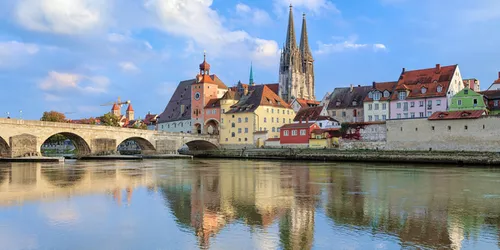
Before setting off on your walking tour of Regensburg, there is one thing you should know: Regensburg is rich in history and offers such a wealth of sights that there is more than enough reason to return after your first day trip. The patrician houses and family towers are particularly characteristic of Regensburg, shaping the cityscape like nowhere else in Bavaria.
To get a first impression of the city, we visit Regensburg’s best-known highlights on this tour. That still leaves plenty to discover on your next visit to this UNESCO World Heritage city.
Discover Regensburg’s Roman history
Our walk around Regensburg’s sights begins at the main railway station. From here, we head north along Maximilianstraße, passing the eastern section of the park surrounding St Emmeram Palace. After around 300 metres, we reach the first small highlight of our tour.
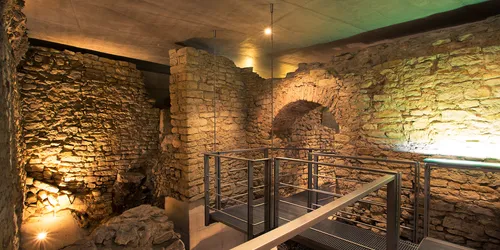
Just north of Ernst-Reuter-Platz, an excavated site reveals remains of the wall that once surrounded the Roman legionary fortress of “Castra Regina”. Recognisable by their large stone blocks, the ancient walls were later integrated into the medieval outer fortifications.
Further sections of the Roman fortress wall can be found around 150 metres farther north in the multi-storey car park at Dachauplatz. Monitors and visual displays in the freely accessible area bring to life the city’s important history on the frontier of the Roman Empire. Together with the excavations at Ernst-Reuter-Platz and Hunnenplatz, these remains form part of the document Legionslagermauer.
Regensburg Cathedral: a Gothic landmark in the Old Town
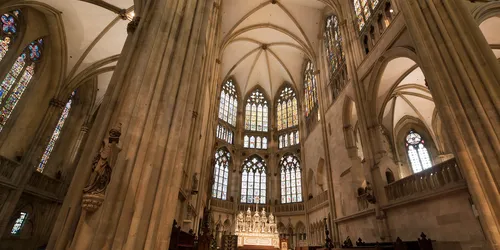
We continue north along Maximilianstraße until it becomes Speichergasse. Passing the Römerturm, an imposing medieval residential and defensive tower, we reach the heart of Regensburg’s UNESCO World Heritage area: St Peter’s Cathedral, one of the city’s best-known sights. The foundation stone for the Gothic building was laid in the second half of the 13th century, although it took around 600 years for the cathedral to assume its present form.
The two spires were not completed until between 1859 and 1869, with the support of the Bavarian kings Ludwig I and Maximilian II. During your visit, look out for the colourful stained-glass windows dating from the 13th and 14th centuries, which bathe the interior in majestic light.
Porta Praetoria: Regensburg’s Roman gateway
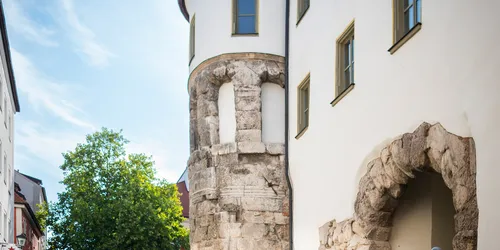
We continue across Krauterermarkt to the street known as Unter den Schwibbögen. Here, you will find another reminder of the city’s Roman origins. The Porta Praetoria is one of Regensburg’s oldest surviving structures and the only preserved Roman gateway north of the Alps. It once served as the northern gate of the Roman legionary fortress of “Castra Regina”.
The Porta Praetoria is almost 2,000 years old. A gateway arch and the remains of a tower have survived, incorporated into the façade of the former bishop’s residence since the 17th century. Without knowing its historical significance, it would be easy to overlook this remarkable sight.
Historische Wurstkuchl: taste a Regensburg speciality
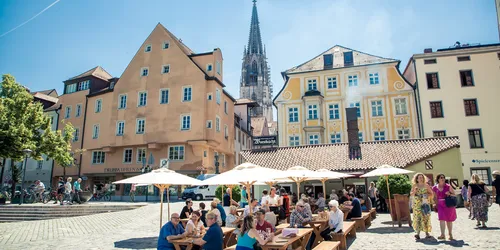
Exploring a city is hungry work. Fortunately, our next stop offers a taste of Regensburg’s culinary history. Following Weiße-Hahnen-Gasse, we reach the southern bank of the Danube and the Historische Wurstkuchl, said to be the oldest sausage kitchen in the world.
Stonecutters and labourers working on the Stone Bridge, as well as dockworkers, stopped here for food as early as the Middle Ages. Today, the family-run restaurant serves sausages from its own butchery, homemade sauerkraut and its well-known Wurstkuchl mustard. Our Regensburg tip: be sure to try them. Enjoy!
Stone Bridge: experience Regensburg above the Danube
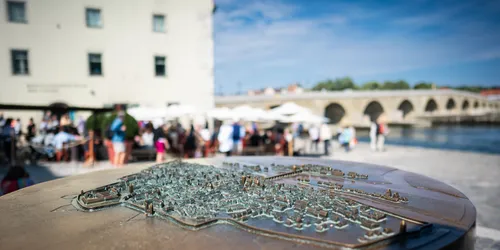
After this short break, our tour of Regensburg’s sights continues beside the Salt Store, which is also home to the UNESCO World Heritage Visitor Centre. Here, the Stone Bridge crosses the Danube and connects Regensburg’s Old Town with the Stadtamhof district, which we will save for our next visit to the city.
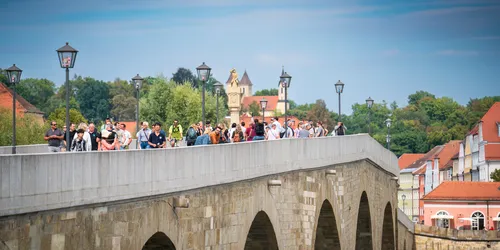
This masterpiece of Romanesque architecture is one of Regensburg’s landmarks and was built between 1135 and 1146. Today, the approximately 315-metre-long bridge crosses the Danube on 15 visible arches. As a permanent river crossing, it was crucial to trade for centuries and contributed to the city’s prosperity.
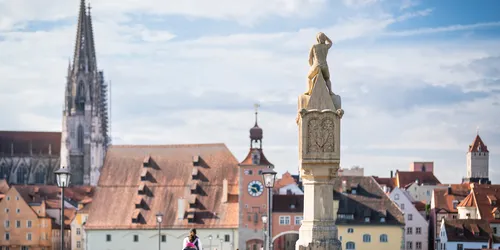
At the highest point of the Stone Bridge, you will come across a stone figure sitting on top of a column. Known as the “Bruckmandl”, the figure gazes towards the cathedral while shielding its eyes from the sun with one hand. A local legend links the figure and its curious gaze to a competition between the builders of the bridge and the cathedral.
Old Town Hall and the Perpetual Imperial Diet
Our tour leads back into the Old Town towards more of Regensburg’s sights. The entrance to the city at the Stone Bridge was originally guarded by three towers. Today, the Bridge Tower still stands at its southern end. From here, we follow Brückstraße south to the Goliath House, one of Regensburg’s largest medieval town houses, before continuing west towards Kohlenmarkt.
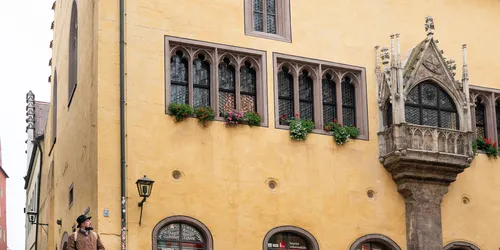
Ahead of you stands Regensburg’s Old Town Hall. Its 55-metre tower, the oldest section of the building, makes it difficult to miss. Additions made over the centuries have divided the town hall into three sections: the tower and adjoining palace, the Gothic Imperial Hall building and the Baroque town hall.
From 1663 until 1806, the former ballroom in the Gothic section hosted the Perpetual Imperial Diet, the permanent assembly of the estates of the Holy Roman Empire. You can visit the historic Imperial Hall, the Imperial Diet Museum and the preserved medieval interrogation chamber on a guided tour of the document Reichstag.
Haidplatz and the Golden Tower in Regensburg
Passing the Old Town Hall, our route continues to Haidplatz, one of Regensburg’s oldest and most historic squares. Once used for festivities and tournaments, the square is framed by magnificent historical buildings and regularly hosts markets and events.
Our Regensburg tip: Café Lila is located directly on Haidplatz. It is a pleasant place to stop for coffee and cake and also offers vegetarian and vegan options.
We leave Haidplatz and its impressive patrician houses behind and gradually make our way back towards the railway station. We follow Rote-Hahnen-Gasse to Gesandtenstraße and turn east. The Old Town’s narrow, winding lanes are home to numerous small traditional shops that invite you to browse. Before reaching Neupfarrplatz, take a look down Untere Bachgasse.
From here, you can already see the Golden Tower rising ahead of you. This 52-metre patrician tower dates from the 13th century. The medieval residence recalls the wealthy merchant families who used buildings like this to display their influence and social standing.
Return to Regensburg Central Station through the palace park
Via St.-Kassians-Platz and Fröhliche-Türken-Straße, we return to the park surrounding St Emmeram Palace. We will save the adjoining St Emmeram Palace for our next trip to Regensburg. The former Benedictine monastery was converted into the residence of the princely House of Thurn and Taxis in the 19th century. With its state rooms, cloister and architecture spanning several eras, it offers plenty to discover on a future visit.
Walking through the palace park and past the Kepler Monument, we return to our starting point at the main railway station.
On your journey home by rail, you have time to reflect on the many impressions gathered among Regensburg’s sights, from the Roman fortress walls to the masterpieces of medieval architecture.
FAQs
Regensburg can be reached by rail from many Bavarian cities, either directly or with only a few changes. You can begin your walk through the Old Town directly from Regensburg Central Station.
The Old Town is only a few minutes’ walk from Regensburg Central Station. Follow Maximilianstraße towards the cathedral and the other sights in the historic centre.
Yes, the main sights in Regensburg’s Old Town are easy to combine on foot. The compact route from the central station to the cathedral, Stone Bridge and Old Town Hall runs mainly through the historic centre.
Regensburg’s best-known sights include St Peter’s Cathedral, the Porta Praetoria, the Stone Bridge, the Historische Wurstkuchl and the Old Town Hall. The patrician houses and family towers also give the Old Town its distinctive appearance.
Allow at least half a day to see the main sights on foot. A full day is worthwhile if you also want to join a guided tour, stop for a leisurely meal or visit additional attractions.
Regensburg’s Old Town and Stadtamhof have been a UNESCO World Heritage Site since 2006. The listing recognises the preserved medieval cityscape, its historic trading buildings and Regensburg’s importance as a political and commercial centre.
Regensburg is particularly well known for grilled sausages served with sauerkraut and sweet mustard. A traditional place to try them is the Historische Wurstkuchl beside the Stone Bridge.
Arrival
St Peter's Cathedral
Domplatz 1
93047 Regensburg
Domplatz 1
93047 Regensburg
Regensburg Hbf
Our tip: Please make sure to check your train connection and the expected capacity before you start your journey.