Destination
The German Toy Museum in Sonneberg: A journey back to childhood
family friendly
all-season
Children's Birthdays
rest stop
Exhibitions
Dolls, model trains and mechanical figures at the German Toy Museum in Sonneberg tell the story of what was once known as the ‘Toy Capital of the World’. Playing and trying things out are an integral part of a visit to this museum.
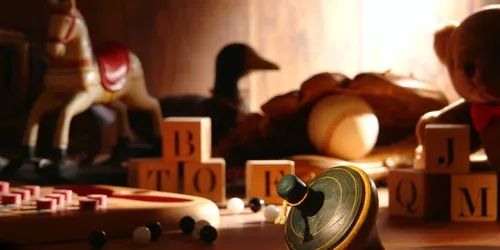
Some toys bring back memories, whilst others fill us with wonder: at the German Toy Museum in Sonneberg, you’ll come across dolls, teddy bears, model railways, mechanical figures and toys from different parts of the world. But it’s not just about looking. Play areas, audio stations and interactive exhibits bring the history of the former ‘World Toy City’ to life.
Sonneberg: the former ‘Toy Capital of the World’
During the 18th and 19th centuries, Sonneberg developed into one of Europe’s most important centres for toy manufacturing. At the start of the 20th century, Sonneberg-based manufacturers played a key role in shaping the international toy trade. As a result, the town earned the nickname ‘Santa’s Workshop’.
The German Toy Museum was founded in 1901 and houses Germany’s oldest specialised collection of toys. The collection includes wooden toys from Sonneberg, figures made from bread dough and papier-mâché, dolls from Thuringia, technical toys, and historical objects from Egypt, East Asia and Africa.
Dolls, model railways and mechanical toys
The tour takes visitors through several floors and themed areas. The mechanical toys section features, amongst other things, vehicles, construction sets and model railways. Some of the exhibits can be set in motion. A historic display serves as a reminder that the well-known model railway manufacturer PIKO remains linked to Sonneberg to this day.
In the dolls’ section, dolls, marionettes and figurines illustrate how materials, fashion and notions of childhood have changed. The manufacturing process is also given due attention: the exhibition shows how publishers, designers and home-based workers collaborated, and the conditions under which toys were produced in the region.
The ‘Thuringian Fair’ as the highlight of the collection
A particular eye-catcher is the ‘Thuringian Fair’ display. It was created for the 1910 World’s Fair in Brussels, where it was awarded the Grand Prix. A total of 67 figures, some of which are almost life-size, depict a lively village fair. Amongst the musicians, traders and revellers, there are always new details to discover.
The historical display group ‘Gulliver in Lilliput’ and mechanical advertising figures also serve as a reminder of the major international appearances made by the Sonneberg toy industry. The restored ‘Elephant with Oasis’ even starts moving again at certain times. You can find out the current demonstration times at the museum.
You’re allowed to play in the Toy Museum
The German Toy Museum sees itself not only as a collection but also as a place to get involved. Play areas, a marble run, marionettes and other stations invite visitors to get active themselves. With a discovery sheet, families can turn their tour into a puzzle adventure.
An audio guide provides additional stories about the Toy Town and the collection. It is available in a version for adults, a version for children and in English, and can be downloaded free of charge onto your own smartphone in advance. During the school holidays, the museum regularly supplements its tour with creative activities and workshops.
Along the ‘Play Mile’ from the station to the museum
The journey into Sonneberg’s toy history begins even before you reach the station. This is where the Sonneberg Play Mile starts, which now connects twelve stops. Figures, play objects, visual experiments and digital elements guide you through the town centre to the Toy Museum.
Along the way, you’ll encounter, amongst other things, toy figures by the Sonneberg designer Renate Müller, a PIKO train set, teddy bears and the ‘Sonneberger Reiterlein’. Some stops can be enhanced via your smartphone using augmented reality. This means that even the walk to the museum becomes part of the outing.
Even more teddy bears and a stop-off in Sonneberg
If, after your visit to the museum, you’d like to delve even deeper into the world of cuddly toys, you can visit the German Teddy Bear Museum on Bahnhofstraße. There, alongside numerous historical and modern bears, you’ll also find particularly large and particularly small specimens. Opening days are limited and should be checked in advance.
Café Isis is a great place to take a break. Another option is the Kesselhaus Sonneberg, which serves German cuisine in a listed former boiler house.
Check the Toy Museum’s opening hours
The German Toy Museum is generally open from Tuesday to Sunday, as well as on many public holidays. It is usually closed on Mondays. Special exhibitions, holiday programmes and demonstrations vary. You should therefore check the current opening times and what’s on before your visit.
Travelling by train to the Sonneberg Toy Museum
Take the train to Sonneberg (Thür) main station. From there, you can either walk directly to the museum or follow the twelve stops along the ‘Spielmeile’ (Toy Mile) through the town centre. The museum is located at Beethovenstraße 10.
Although Sonneberg is in Thuringia, the station can be reached using the Bayern-Ticket. The Regio-Ticket Franken-Thüringen is also valid on the route via Nuremberg, Bamberg, Lichtenfels, Neustadt bei Coburg and Sonneberg. Please check the current terms and conditions of your chosen ticket before travelling.
FAQs
Arrival
German Toy Museum
Beethovenstraße 10
96515 Sonneberg
Beethovenstraße 10
96515 Sonneberg
Sonneberg(Thür) Hbf
Our tip: Please make sure to check your train connection and the expected capacity before you start your journey.