Yes, Passau is an excellent destination for a day trip by train. Its Baroque Old Town, St Stephen’s Cathedral, the Three Rivers Point, Veste Oberhaus and other major sights can be explored on an extended walking tour.
Destination
A walk through the Three Rivers City of Passau
highlight
City Trip
Historically Relevant
Architectural Highlight
Exhibitions
rest stop
Visit the historic baroque city of Passau on the three rivers Danube, Inn and Ilz on an excursion by train. Experience the Mediterranean flair that flows through the small streets and go on a journey of discovery to Passau's most beautiful sights.

Discover the picturesque city of Passau, its impressive architecture, vibrant culture and attractive scenery on a walking tour. The centre of Passau’s Old Town is characterised by colourful Baroque buildings and winding alleyways. Passau was almost completely destroyed by the devastating city fire of 1662. Italian artists played a particularly important role in rebuilding the city, giving Passau its present-day southern European and Baroque appearance.
With its three rivers, numerous boats and narrow Baroque alleyways, the city resembles a smaller version of Venice and has therefore earned the nickname "Venice of Bavaria".
Passau’s Old Town: from the main railway station to the historic centre
Our walking tour through Passau’s winding alleyways begins at the main railway station. The Neoclassical station building was constructed in 1860 and is located close to the historic centre. This is where we are heading now. Follow Bahnhofstraße towards the Old Town and continue across Ludwigsplatz into Ludwigstraße. At the historic cistern at the end of the street, turn into Grabengasse and follow it to Carlonegasse.
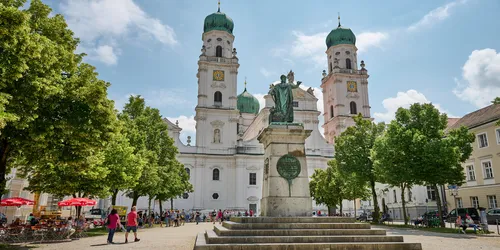
This small alleyway takes us directly to Cathedral Square, where the imposing façade of Passau’s Baroque cathedral immediately catches our eye.
Passau Cathedral and the world’s largest cathedral organ
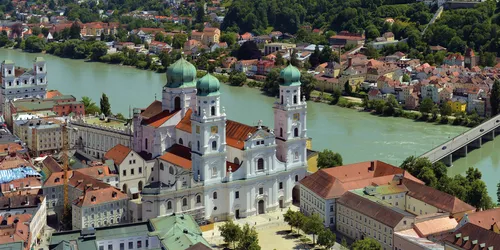
No walking tour of Passau would be complete without a visit to the cathedral. Passau Cathedral has shaped the city’s appearance for centuries. This majestic place of worship was first documented as an episcopal church in 730 and remains the seat of the bishop and the principal church of the Diocese of Passau. After the cathedral was almost completely destroyed in the devastating city fire of 1662, it was rebuilt in the Baroque style and acquired its present appearance.
The church impresses visitors with its imposing size and distinctive architecture, which combines elements of the Baroque, Renaissance and Gothic periods. Featuring the largest Baroque church interior north of the Alps, the cathedral creates an impressive atmosphere with its soaring ceilings and elaborate stucco decorations.
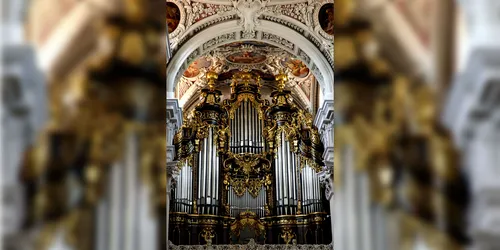
A particular attraction inside Passau Cathedral is the world’s largest cathedral organ. Its 17,974 pipes and 233 stops produce a majestic sound that never fails to astonish visitors. At one of the many organ concerts, you can experience the energy and grace of the music created by this remarkable instrument.
The combination of powerful, majestic sounds and delicate melodies, enhanced by the acoustics of the impressive building, is sure to leave a lasting impression. The lunchtime organ concerts are particularly worth attending. From 2 May to 31 October, the cathedral musicians play music from different periods on the world-famous organ from Monday to Saturday at 12 noon. There are no lunchtime organ concerts on Sundays or public holidays. You can find the latest dates and ticket information here.
Important information: Passau Cathedral’s organ is currently undergoing extensive restoration. Until the work is expected to be completed in 2028, not all of its individual organ divisions can be played. The organ concerts will continue to take place.
Residence Square in Passau: discover Baroque architecture
We leave the cathedral and follow Zengergasse around the rear of the building to Residence Square. Together with the surrounding buildings, this picturesque square forms a harmonious architectural ensemble. The cathedral’s Gothic choir rises to the west, the Baroque façade of the residence encloses the southern side and the water of the Wittelsbach Fountain ripples in the centre.
Cafés and restaurants around Residence Square invite you to take a break while enjoying views of the historic buildings and the lively activity on the square.
Schaibling Tower: a popular photo subject on the Inn promenade
Our route continues eastwards along Schustergasse to St Michael’s Church. We follow the small Schwabgäßchen in front of the church to the banks of the Inn. Heading east along Innkai, we soon catch sight of the Schaibling Tower. This whitewashed round tower with its red roof was constructed in 1250. Over the centuries, it served as a defensive tower, storage building, landing place and temporary accommodation for actors from the former Passau Kammerspiele theatre.
With its pointed roof, the tower is an eye-catching landmark and a popular photo subject on the Inn promenade. We pass the tower on our walking tour of Passau and follow the Inn to its confluence with the Danube.
Passau’s Three Rivers Point: where the Danube, Inn and Ilz meet
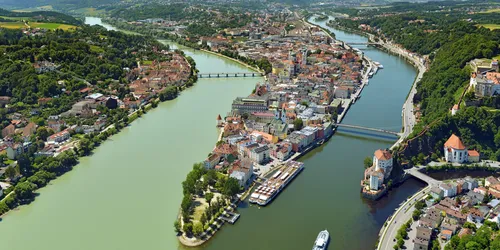
After approximately 350 metres, we reach the mouth of the Inn. What awaits us here is far more impressive than an ordinary river confluence. At the Three Rivers Point, a peninsula between the Danube and the Inn, the Danube, Inn and Ilz approach from three different directions before continuing together in a fourth.
The different colours and currents create a fascinating natural spectacle. Here, the black water of the Ilz meets the blue-brown Danube and the green Inn. We now follow the Danube upstream and turn into Bräugasse after approximately 230 metres.
On the corner of Römerplatz is the Altes Bräuhaus, where we can stop for refreshments before continuing our walk. This Bavarian restaurant occupies the historic vaulted rooms of a former brewery whose history dates back to the 14th century. Today, hearty Bavarian dishes and local beer specialities are served in the vaulted rooms and on the sunny terrace.
Veste Oberhaus: history and panoramic views over Passau
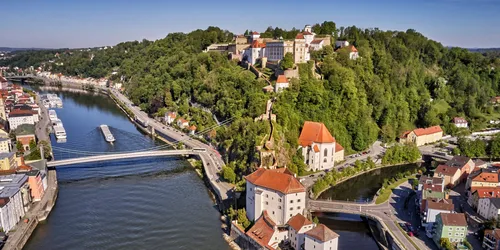
We continue our walking tour across the Prince Regent Luitpold Bridge, which opened in 1910, to the northern bank of the Danube. At the junction, the Ludwigsteig path climbs to Veste Oberhaus. This medieval castle complex on a hill north of Passau was built in the 13th century and served as an important defensive position during numerous wars and conflicts. With an enclosed area of around 65,000 square metres, Veste Oberhaus is one of the largest surviving castle complexes in Europe.
Today, Veste Oberhaus is a popular attraction and houses a museum dedicated to the history of the castle, Passau and the surrounding region. The permanent exhibition "Fascination of the Middle Ages" presents medieval art, including paintings, sculptures and handicrafts. The museum also features exhibitions about Passau’s history, guilds and crafts, as well as a historic pharmacy.
The fortress offers impressive panoramic views of Passau, its three rivers and the surrounding hills. The 18th-century observation tower is particularly worth visiting. In addition to its sweeping views, the tower houses a multimedia exhibition.
The exhibition explores the diverse history of the German-Austrian border region and explains the important role played by the Inn, Salzach and Danube rivers. Allow enough time during your walking tour, as there is plenty to discover at Veste Oberhaus. The Oberhausmuseum and observation tower open seasonally, so check the current opening hours before your visit.
Passau’s Old Town Hall and Glass Museum
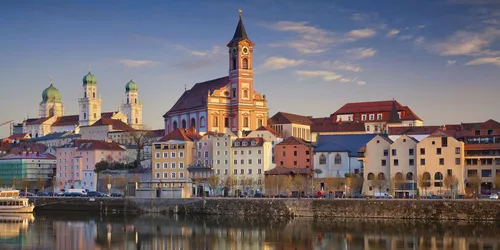
We gradually begin our return journey, descending along the same route and crossing the Luitpold Bridge once again. We then turn west into Fischmarktgasse. After 70 metres, we enter Town Hall Square. On its southern side stands the Old Town Hall with its distinctive tower.
This impressive 14th-century building is a remarkable example of Gothic architecture in the region. It contains several magnificent ceremonial halls used for public events and celebrations. One of the best-known rooms is the Grand Town Hall, whose elaborate ceiling paintings and chandeliers provide a splendid setting for concerts and festive events.
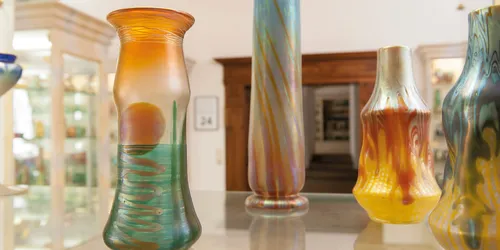
Directly beside the Old Town Hall, in a historic building complex on Town Hall Square, is the Passau Glass Museum. Its approximately 15,000 glass objects provide a comprehensive insight into glass production in Bavaria, Bohemia, Austria and Silesia between 1650 and 1950.
Through Höllgasse back to Passau railway station
From Town Hall Square, our walk continues into picturesque Höllgasse. Numerous artists and craftspeople have established workshops here and display their work. Every spring, artists repaint the colourful paving stones that lead through the alleyway. At the end of Höllgasse, take Schlosserstiege to Steinweg. We follow this street westwards to return to the starting point of our tour.
The route changes its name several times. Steinweg first becomes Rindermarkt, then Roßtränke, Kleine Klingergasse and finally Bratfischwinkel before turning into Frauengasse. At Schanzl, we return to Bahnhofstraße and make our way back to the starting point.
Full of new impressions of Passau, the City of Three Rivers, we can relax on the train journey home. You may already be wondering what to experience on your next visit. With three rivers flowing through the city, Passau is the perfect place for an exploration by boat. Further attractions also await discovery in the south of Passau.
These include the Roman Museum at Boiotro Fort and the Mariahilf pilgrimage church and monastery, both of which are well worth visiting. As you can see, there are plenty of other beautiful places to discover on another trip to Passau.
FAQs
Passau can be reached by regional train from various cities in Bavaria. Passau’s main railway station is close to the city centre, allowing you to start exploring the City of Three Rivers as soon as you arrive.
From the main railway station, follow Bahnhofstraße and cross Ludwigsplatz towards the Old Town. Ludwigstraße, Grabengasse and Carlonegasse lead to Cathedral Square and St Stephen’s Cathedral.
Yes, many of Passau’s sights can be easily combined on a walking tour. However, the Ludwigsteig path to Veste Oberhaus is steep, so comfortable, sturdy shoes are recommended.
Passau’s best-known sights include St Stephen’s Cathedral, Residence Square, Schaibling Tower, the Three Rivers Point, Veste Oberhaus, the Old Town Hall, the Glass Museum and Höllgasse.
Allow a full day to explore Passau’s main sights and enjoy a relaxed meal. If you also want to visit the Oberhausmuseum, attend an organ concert or take a boat trip, consider staying longer.
The Danube, Inn and Ilz meet in Passau. At the Three Rivers Point, you can see the green water of the Inn, the blue-brown Danube and the black Ilz flowing together.
The organ in St Stephen’s Cathedral is considered the largest cathedral organ in the world. It has 17,974 pipes and 233 stops distributed across five separate organ divisions.
Arrival
Passau
Bahnhofstraße 29
94032 Passau
Bahnhofstraße 29
94032 Passau
Passau Hbf
Our tip: Please make sure to check your train connection and the expected capacity before you start your journey.