Destination
Museum in the Kulturspeicher, Würzburg: Art in the old granary
Culturally Important
Events
Exhibitions
rest stop
all-season
Where grain was once stored at the Old Harbour, we now discover art spanning three centuries: from Emy Roeder’s sculptures to photographs created entirely without a camera.
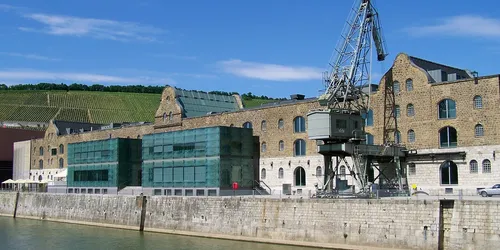
Arched windows and tall gables line the banks of the Main in Würzburg. From the outside, the old granary is still clearly recognisable. Inside, historic building fabric meets modern architecture. Spanning some 3,500 square metres, the Museum im Kulturspeicher showcases art from the 19th to the 21st century. We’ll be exploring two collections that offer very different perspectives on art.
From granary to art museum at the Old Harbour
The building was constructed in 1904 as a warehouse at the Old Harbour. Almost a century later, the architectural firm Brückner & Brückner converted the granary into a cultural quarter. In 2002, the Städtische Galerie moved in. Its history stretches further back: it was founded in 1941 on the instructions of the then Nazi city government. Today, the museum also investigates the origins of the works in its collection and the circumstances under which they were acquired.
Municipal Collection: From Painting to Emy Roeder’s Sculptures
The Municipal Collection features works of German Realism and Impressionism, as well as works by modern artists. In addition to paintings and sculptures, the collection includes prints, letters and estates. The sculptor Emy Roeder has particularly close ties to Würzburg. Her estate comprises not only sculptures, but also drawings and correspondence. It demonstrates the versatility of this Würzburg-born artist’s work.
Concrete Art: What Colour, Form and Light Tell Us
In the Peter C. Ruppert Collection, our perspective shifts. Instead of recognising landscapes or people, we follow lines and areas of colour. In Concrete Art, such design elements stand on their own: a square need not represent anything for its colour or position within the picture to have an effect. The collection demonstrates the diverse ways in which artists across Europe have engaged with this concept since 1945.
Concrete photography is particularly unusual. Some works are created without a camera: light acts directly on light-sensitive material, producing shapes or traces without the need to photograph a visible scene. Alongside the two collections, the museum hosts temporary exhibitions. You can find out which works and themes are currently in the spotlight in the museum’s latest programme.
After the museum: a stop at the Old Harbour or cabaret at the Bockshorn
If your stomach is rumbling after the tour, you can stop off at Jule’s Hafenschänke at the Old Harbour. They serve home-cooked dishes and, weather permitting, there’s a spot outside in the beer garden. You can find the current opening hours on the Hafenschänke’s website.
If you’d like to combine your trip with a visit to the theatre, you’ll also find the Bockshorn at the Kulturspeicher, featuring cabaret and comedy. Or you can continue along the Main towards the Alte Mainbrücke. You’ll find suggestions for your walk to the old town in our city tour of Würzburg.
Travelling by train to the museum at the Kulturspeicher in Würzburg
Take the train to Würzburg Hauptbahnhof. Keep to the right on the station forecourt and walk past the bus station to Bismarckstraße. Follow this road until you reach Veitshöchheimer Straße, then turn left. The museum is located at Oskar-Laredo-Platz 1. According to the museum, it’s about a 15-minute walk. Alternatively, bus 13 runs from the coach station directly to the Kulturspeicher. You can find the current opening times and admission prices on the museum’s website.
FAQs
Special exhibitions
Arrival
Würzburg Cultural Centre
Oskar-Laredo-Platz 1
97080 Würzburg
Würzburg Hbf
Our tip: Please make sure to check your train connection and the expected capacity before you start your journey.